Homemade Strawberry Rose Macarons: An Exquisite Mother’s Day Gift
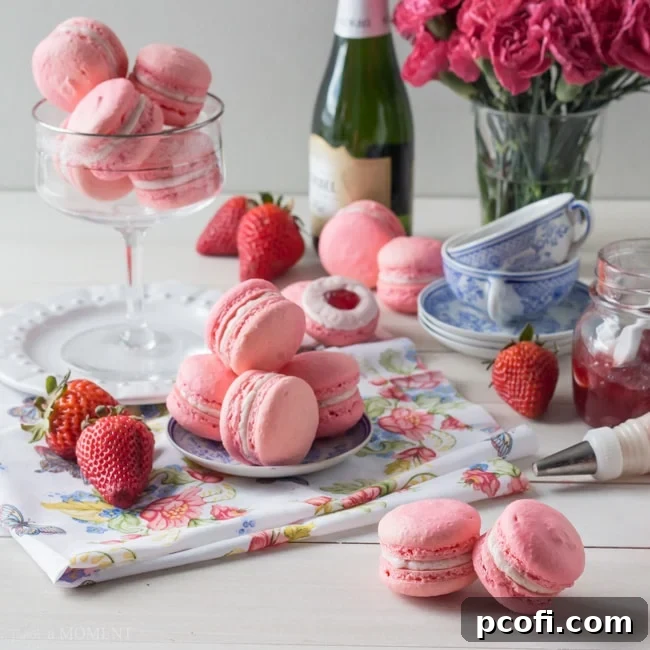
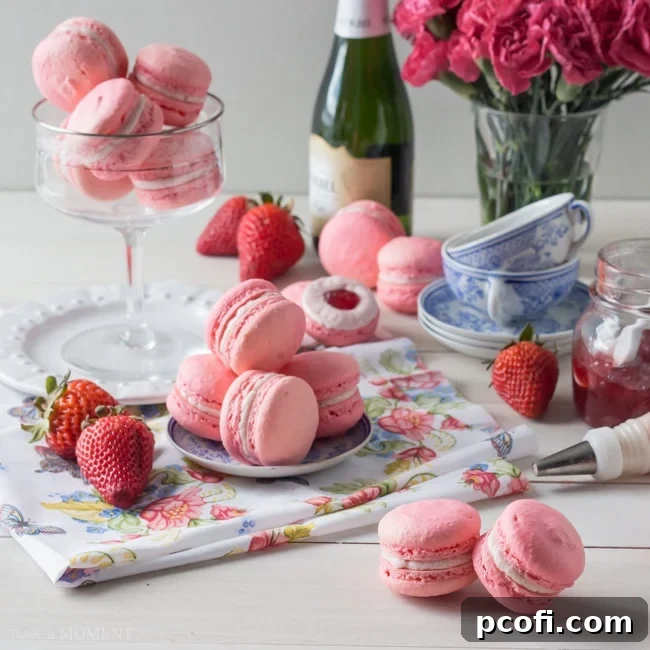
This Mother’s Day, go beyond the ordinary and craft a gift that truly comes from the heart: a batch of homemade Strawberry Rose Macarons. These delicate French confections, with their signature crisp shells, chewy interiors, and a lusciously flavored filling, are more than just a dessert. They are a profound gesture of love and appreciation, embodying elegance, effort, and a truly unique flavor profile that makes them an unforgettable present for any mother figure.
The allure of macarons lies in their intricate beauty and sophisticated taste. While often perceived as challenging to make, the journey of baking macarons can be incredibly rewarding. With precise measurements, proper technique, and a dash of patience, you’ll be able to create these stunning pastel-pink treats that are as delightful to look at as they are to savor. The harmonious blend of sweet, ripe strawberries and the subtle, intoxicating fragrance of rosewater transforms these macarons into an edible work of art, perfectly suited for such a special occasion.
Why Strawberry Rose Macarons are the Ultimate Mother’s Day Treat
The flavor combination of strawberry and rose is a timeless pairing that exudes grace and sophistication. Strawberries offer a burst of vibrant, natural sweetness with a hint of tartness, reminiscent of blooming spring gardens and fresh beginnings. This bright fruitiness is beautifully complemented by the delicate, almost ethereal floral notes of rosewater, which adds a layer of luxurious fragrance without overpowering the palate. The result is a balanced, nuanced flavor that is both comforting and deeply elegant, a true reflection of the multifaceted love we hold for our mothers.
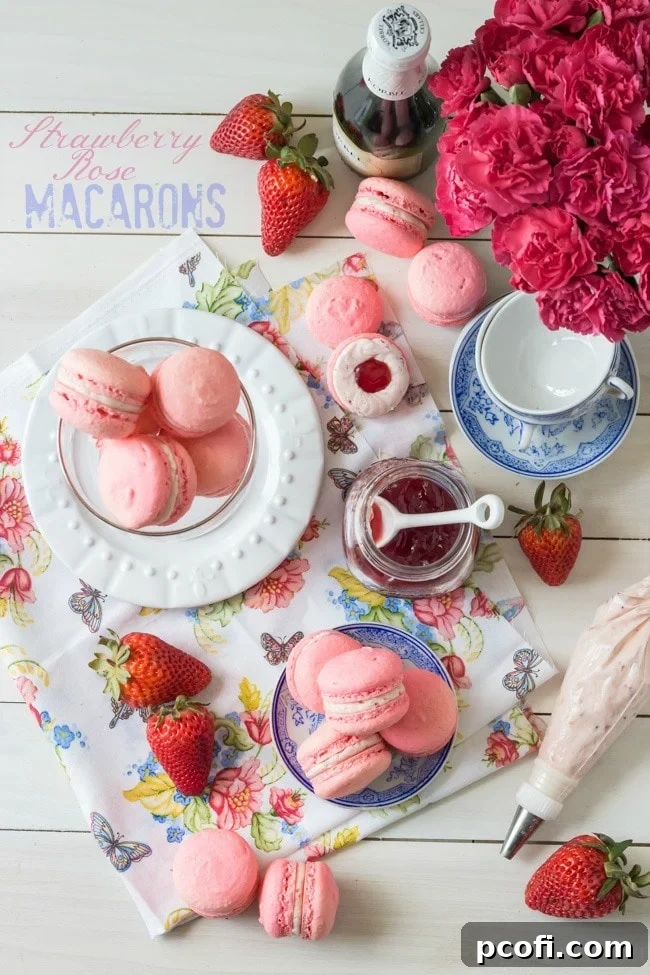
Beyond their exquisite taste, Strawberry Rose Macarons are visually captivating. Their tender pink hue, easily achieved with a touch of gel food coloring, evokes softness and warmth. Each perfectly domed shell boasts the coveted “foot” – a ruffled edge that signifies a successful bake and adds to their iconic charm. The contrast between the fragile, crisp exterior and the soft, chewy almond meringue, cradling a rich strawberry rose buttercream and a dollop of strawberry jam, creates a multi-textured experience that is pure bliss. Gifting these handmade beauties shows thoughtfulness and dedication, making them a truly personal and cherished present.
Mastering Macaron Baking: Essential Tips for Perfect Shells
The reputation of macarons as a notoriously difficult pastry often deters many home bakers. However, with a clear understanding of the process and a few insider tips, you can achieve macaron success. This recipe employs the Swiss meringue method, which is known for its stability and can be more forgiving for those new to macaron making. It involves gently heating egg whites and sugar over a double boiler before whipping them into a glossy meringue, providing a strong foundation for your shells.
Here are crucial steps and considerations to ensure your macaron shells turn out perfectly:
- Precision with Ingredients: Macarons are a science. Always use a digital kitchen scale to measure ingredients by weight, not volume. Even slight variations in flour or sugar can drastically alter the batter’s consistency.
- Quality Almond Flour: Use blanched, superfine almond flour. For an even smoother texture, pulse the almond flour together with the powdered sugar in a food processor, then sift the mixture at least once (preferably twice) to remove any larger granules or lumps. Discard any bits that don’t pass through the sieve.
- Room Temperature Egg Whites: Ensure your egg whites are at room temperature. While some bakers swear by “aging” egg whites (separating them a day or two in advance and letting them sit covered at room temperature), simply bringing them to room temperature for at least 30 minutes before whipping is sufficient for this recipe. Room temperature whites whip up with more volume and stability.
- Achieving Stiff Peaks: Whip your egg whites until they form stiff, glossy peaks. This means when you lift the whisk, the meringue holds its shape firmly without collapsing. Over-whipping can make the meringue too dry, while under-whipping won’t provide enough structure.
- The Art of Macaronage: This is the most critical step. Macaronage refers to the gentle folding of the almond flour mixture into the meringue. The goal is to deflate the meringue just enough to create a “lava-like” batter that flows slowly and continuously off your spatula in a ribbon. If the ribbon breaks, it’s under-mixed. If it flows too quickly, it’s over-mixed. Practice makes perfect here!
- Piping Consistency: Use a sturdy piping bag fitted with a large round tip (like Wilton 1A or Ateco 805) for consistent macaron size. Hold the bag perpendicular to the baking sheet and pipe uniform rounds.
- Tapping the Trays: After piping, firmly tap your baking sheets against the counter several times. This releases any trapped air bubbles, which can cause cracked shells. You can also use a toothpick to pop any visible bubbles.
- Drying Time (Pied Formation): Allow your piped macaron shells to “rest” at room temperature until a skin forms. This is crucial for developing the characteristic “feet.” When you gently touch the surface, it should feel dry and not sticky. This can take anywhere from 20 minutes to over an hour, depending on your kitchen’s humidity.
- Oven Temperature: Every oven is different, and temperature consistency is paramount for macarons. Invest in an oven thermometer to ensure accuracy. The initial high temperature followed by a drop helps to create the feet and prevents cracking.
Key Ingredients & Essential Tools for Your Macaron Success
Beyond technique, having the right ingredients and equipment streamlines the macaron-making process and contributes significantly to your success. Here’s what you’ll need:
Key Ingredients Spotlight:
- Almond Meal (Almond Flour): The foundation of macaron shells, providing that distinct nutty flavor and chewy texture. Ensure it’s superfine for smooth shells.
- Powdered Sugar (Confectioners’ Sugar): Blended with almond meal for sweetness and structure.
- Granulated Sugar: Used in the meringue to provide stability and sweetness.
- Egg Whites: The backbone of the meringue. Fresh, room-temperature egg whites are crucial.
- Gel Paste Food Coloring: Provides vibrant color without adding excess liquid, which can ruin macaron batter.
- Fresh Strawberries: For the bright, fruity notes in the buttercream and the jam filling.
- Rosewater: The star of the delicate floral aroma, adding sophistication to your filling. Use culinary-grade rosewater for the best flavor.
- Unsalted Butter: The base for a rich and creamy Swiss meringue buttercream.
- Strawberry Jam or Preserves: Adds an extra burst of strawberry flavor and a textural contrast to the filling.
Essential Tools for Macaron Mastery:
- Digital Kitchen Scale: Absolutely essential for accurate ingredient measurement. Precision is non-negotiable for macarons.
- Stand Mixer with Whisk Attachment: While possible by hand, a stand mixer makes whipping the meringue significantly easier, faster, and more consistent.
- Food Processor: Necessary for finely grinding almond meal with powdered sugar, ensuring a smooth shell.
- Fine-Mesh Sieve: To sift your dry ingredients, preventing lumps and ensuring delicate shells.
- Piping Bags & Round Tips: A large round tip (e.g., Wilton 1A, Ateco 805) is ideal for piping consistent macaron shells.
- Silicone Baking Mats or Parchment Paper: Silicone mats are highly recommended for even baking and easy release. If using parchment, consider printing or drawing macaron templates on the underside for uniform sizing.
- Sturdy Baking Sheets: Flat, heavy-gauge baking sheets help distribute heat evenly.
- Rubber Spatula: Essential for the delicate folding process during macaronage.
- Oven Thermometer: Critical for ensuring your oven’s temperature is accurate, as oven fluctuations can lead to macaron failures.
For more comprehensive guidance on mastering the fundamentals of macaron baking, including detailed explanations of techniques and common pitfalls, please refer to my Basic Macaron Recipe guide. It’s an invaluable resource for both beginners and those looking to refine their skills.

Strawberry Rose Macarons
Leave a Review
Ingredients
For the shells:
- 4 large (120 g) egg whites
- 220 grams powdered sugar
- 140 grams almond meal
- 80 grams granulated sugar
- A few drops gel paste food coloring (pink or red)
For the filling (Strawberry Rose Buttercream):
- 1 large (30 g) egg white
- 1/3 cup (66.67 g) granulated sugar
- 6 tablespoons (88.72 g) unsalted butter, slightly softened
- 3 large fresh strawberries, pureed or finely chopped
- 5-6 drops rosewater
- 2 tablespoons strawberry jam or preserves
Instructions
To make the shells:
- Place the egg whites in a large mixing bowl, covered, and allow them to come to room temperature. This typically takes 30-60 minutes, and ensures better volume when whipping.
- In a food processor, combine the powdered sugar and almond meal. Pulse for about 30 seconds until the mixture is very fine. Sift the mixture into a clean bowl to remove any larger almond pieces or lumps that could affect the macaron’s smooth texture. Discard any coarse bits remaining in the sieve.
- Using a stand mixer fitted with the whisk attachment, whip the room-temperature egg whites on medium-high speed until they become foamy and soft peaks form.
- Slowly and gradually add the granulated sugar to the whipping egg whites. Continue whipping on high speed until the meringue is stiff, glossy, and holds firm peaks when the whisk is lifted.
- Add a few drops of gel paste food coloring (pink or red is recommended for a strawberry hue) to the meringue. Briefly whip again until the color is evenly distributed and the meringue maintains its stiff consistency.
- Gently add the sifted almond meal/powdered sugar mixture to the meringue, all at once. Using a rubber spatula, begin folding (macaronage) the dry ingredients into the meringue. Fold carefully, scraping the sides and bottom of the bowl, until the batter reaches a “lava-like” consistency. It should flow off your spatula in a continuous ribbon and slowly melt back into the bowl within 10-15 seconds. Be careful not to overmix, as this will lead to flat, footless macarons.
- Transfer the macaron batter into a pastry bag fitted with a large round tip (e.g., Wilton 1A).
- Pipe 1-inch diameter rounds onto parchment-lined or silicone mat-lined baking sheets, leaving about an inch of space between each shell. Firmly tap the baking sheets on your counter 2-3 times to release any trapped air bubbles. Pop any remaining small bubbles with a toothpick.
- Allow the piped macarons to dry at room temperature for 20-30 minutes, or longer depending on humidity. A thin, dry membrane (skin) should form on the surface, which you can gently touch without the batter sticking to your finger. This step is essential for the “feet” to develop.
- Preheat your oven to 375 degrees F (190 C). Once preheated, place the baking sheet in the oven and immediately drop the temperature down to 325 degrees F (160 C).
- Bake for 14 minutes. Avoid opening the oven door during baking.
- Remove the macarons from the oven and allow them to cool completely on the baking sheet before attempting to remove them. This prevents breakage and ensures they set properly.
To make the filling (Strawberry Rose Buttercream):
- In a large mixing bowl, combine the egg white and granulated sugar. Whisk them together until well combined and the sugar starts to dissolve.
- Place the bowl over a small pot of simmering water (creating a double boiler setup). Cook, whisking continuously, for about 5 minutes, or until the sugar has completely dissolved and the mixture no longer feels gritty when rubbed between your thumb and forefinger. This pasteurization step makes the buttercream safe to eat.
- Remove the bowl from the heat. Using a stand mixer with the whisk attachment, whip the mixture on high speed until it cools completely and forms a stiff, glossy meringue. The bowl should feel cool to the touch (this can take 5-10 minutes).
- Switch to the paddle attachment (if using a stand mixer). Begin adding the slightly softened unsalted butter, one tablespoon at a time, whipping well after each addition. The mixture may look curdled or separated at first, but continue to whip; it will eventually come together into a smooth, fluffy buttercream. If it seems too runny, place it in the fridge for 15 minutes to firm up slightly, then continue whipping.
- Once the buttercream is thick and fluffy, add the pureed fresh strawberries and the 5-6 drops of rosewater.
- Whip on high speed again until the strawberry rose buttercream is fully combined, light, and perfectly smooth.
To assemble the macarons:
- Once the macaron shells are completely cooled, pair them up by size. Pipe the strawberry rose buttercream in a neat ring around the outside edge of the flat bottom side of one macaron shell.
- Carefully spoon or pipe about 1/8 teaspoon of strawberry jam or preserves into the center well created by the buttercream ring. This adds a burst of intense strawberry flavor.
- Gently place another macaron shell on top, pressing lightly to secure it and evenly distribute the filling.
Notes
Tried this recipe? Mention @bakingamoment on Instagram or tag #bakingamoment.
Troubleshooting Common Macaron Challenges
Even with careful attention, macarons can sometimes present unexpected challenges. Don’t let imperfections discourage you! Understanding common issues and their solutions will help you refine your technique with each batch:
- No Feet or Flat Macarons:
- Cause: This is often due to incorrect macaronage (either under-mixed or over-mixed batter) or insufficient drying time before baking.
- Solution: Ensure your batter flows like a slow ribbon. Be patient with the drying step; the skin must be fully formed.
- Hollow Macarons:
- Cause: Typically caused by an oven temperature that’s too high, or sometimes under-mixed batter that hasn’t fully deflated.
- Solution: Double-check your oven temperature with a thermometer. Try lowering the temperature slightly (e.g., by 5-10 degrees F) or adjusting baking time. Perfect your macaronage technique.
- Cracked Shells:
- Cause: Trapped air bubbles in the batter, shells that haven’t adequately dried, or an oven that’s too hot.
- Solution: Tap your baking sheets firmly several times after piping to release air. Ensure the shells form a dry skin. Verify your oven temperature accuracy.
- Lumpy or Grainy Shells:
- Cause: Almond flour not finely ground enough or not thoroughly sifted.
- Solution: Always process your almond meal with powdered sugar, and sift the mixture at least once (preferably twice) to ensure a superfine consistency.
- Uneven Baking or Browning:
- Cause: Hot spots in your oven, or uneven heat distribution from the baking sheet.
- Solution: Rotate your baking sheets halfway through the baking time. Consider using two baking sheets stacked together to insulate the bottoms of the macarons and prevent over-browning.
Storage, Freezing, and Gifting Your Homemade Macarons
One of the best qualities of macarons is their ability to hold their freshness, and even improve, over time. Proper storage ensures their delicate texture and vibrant flavors are preserved, making them an ideal make-ahead treat or gift.
- Storage (Assembled Macarons): Once assembled, macarons are best enjoyed the day after they are filled. This “maturation” period allows the filling’s moisture to soften the shells slightly, resulting in that perfectly tender, chewy interior. Store them in an airtight container in the refrigerator for up to 5 days. For optimal flavor and texture, allow them to come to room temperature for 15-20 minutes before serving.
- Storage (Unfilled Shells): If you prefer to make the shells in advance, store them in an airtight container at room temperature for up to 2-3 days, or freeze them for longer.
- Freezing Macarons: Macarons, both filled and unfilled, freeze exceptionally well!
- Filled Macarons: Place them in a single layer in an airtight container, separating layers with parchment paper. Freeze for up to 1 month. Thaw in the refrigerator overnight, then bring to room temperature for 15-30 minutes before serving.
- Unfilled Shells: Freeze in an airtight container for up to 3 months. Thaw at room temperature and then fill as desired.
- Gifting Your Creation: Presenting your homemade Strawberry Rose Macarons is almost as delightful as baking them! Arrange them elegantly in a small, sturdy gift box lined with tissue paper or crinkle-cut shreds. Clear cellophane bags tied with a beautiful ribbon also make for a lovely presentation. A small handwritten tag indicating the flavor (Strawberry Rose!) and perhaps a little note about your baking journey adds a heartfelt personal touch that will make your gift truly cherished.
As an Amazon Associate I earn from qualifying purchases.
These exquisite Strawberry Rose Macarons are more than just a dessert; they are a celebration of culinary artistry and heartfelt gifting. The delicate balance of sweet, fresh strawberries and aromatic rosewater, encased in perfectly baked almond meringue shells, creates a treat that is truly special. This Mother’s Day, embrace the joy of baking and present a gift that speaks volumes of love and appreciation. Your efforts will undoubtedly be savored and remembered.
For more delicious and inspiring recipes perfect for Mother’s Day or any festive occasion, be sure to explore my dedicated Mother’s Day recipes category. You’ll find a treasure trove of ideas to make every celebration extra sweet.