
Mastering the Art of Homemade Croissants: A Simplified Recipe for Flaky Perfection
Are you dreaming of biting into a perfectly flaky, irresistibly buttery croissant, fresh from your own oven? This comprehensive guide presents a simplified **croissant recipe** designed for home bakers of all skill levels. Forget the intimidating processes and complex techniques often associated with traditional French patisserie; we’re breaking down the steps to help you achieve beautifully authentic results with ease. Get ready to bake like a pro and savor the unparalleled delight of **homemade croissants** that are both deliciously authentic and surprisingly easy to make!

Today marks the day we tackle a baking challenge that has long been on many enthusiasts’ bucket lists: crafting exquisite **homemade croissants**. For years, the idea of making these iconic pastries at home felt daunting, with countless recipes promising varying levels of difficulty. However, drawing inspiration from our successful easy puff pastry recipe, we embarked on a mission to develop a croissant method that is quicker, less complicated, and far more approachable than conventional approaches.
After dedicated experimentation and refinement, we’re thrilled to share a version that dramatically simplifies the process. You’ll be amazed at how much easier this **homemade croissant recipe** is, without compromising on the divine taste and texture that makes a croissant truly special.

What Exactly is a Croissant? Unveiling the French Pastry Masterpiece
For those who have yet to experience the sheer delight of a classic French croissant, prepare for an extraordinary culinary treat! At its heart, a croissant is an iconic French pastry, distinctively shaped into a crescent moon. It’s renowned for its unique combination of textures and flavors: incredibly light, airy, and rich with butter, often boasting a delicate sweetness. Beneath its crisp, golden exterior lies a soft, slightly chewy interior with a yeasty, stretchy texture that is utterly unique. There truly is no other pastry quite like it.
Croissants come in a delightful array of variations, catering to diverse palates. Popular choices include the decadent chocolate croissants, known as pain au chocolat, rich almond croissants, and numerous other fillings. The beauty of baking them yourself lies in using wholesome, real ingredients like high-quality butter and fresh milk, which elevates the flavor profile to an unbelievable level. Once you taste a truly **homemade croissant**, you’ll understand why store-bought versions simply can’t compare.
At the core of the croissant’s magic is its classification as a “laminated pastry.” This intricate technique involves repeatedly folding a yeast-leavened dough with layers of cold butter. As the croissant bakes, the butter within these tissue-thin layers melts and creates steam, which then forces the dough layers apart, resulting in an incredibly airy, flaky, and exceptionally delicious pastry. This lamination process is key to achieving that signature delicate crunch and tender crumb.
To delve deeper into the fascinating world of laminated pastry doughs and their various applications, you might explore other related recipes such as our puff pastry recipe, these charming homemade crescent rolls, a perfectly flaky pie crust, or our delightful Danish dough. Each showcases a different facet of this elegant baking method.
Croissant vs. Puff Pastry: Understanding the Key Differences
While the delicate, multilayered texture of a croissant often draws comparisons to puff pastry, there are several crucial distinctions that set them apart. The primary difference lies in their composition: traditional puff pastry is entirely savory, containing no sugar whatsoever, which contributes to its more neutral flavor profile.
Crucially, croissants are a yeast-leavened pastry, meaning they contain active yeast that helps the dough rise and develop its characteristic airy interior and subtle yeasty flavor. In contrast, puff pastry relies solely on the steam created by melting butter between its layers for its lift, making it a “quick” or un-leavened pastry. Additionally, croissants are typically made with milk, which contributes to a richer, softer dough, whereas puff pastry generally uses water. These differences highlight the distinct culinary identities of these two laminated marvels.
Croissant vs. Danish Pastry Dough: A Subtle Yet Significant Distinction
When comparing croissants to other laminated doughs, they share more similarities with Danish pastry dough than with puff pastry. Both croissants and Danish pastries are yeast-leavened and contain sugar and milk, resulting in a rich, slightly sweet, and tender crumb. However, there’s one notable difference in their core ingredients: Danish dough traditionally incorporates eggs, which add richness, color, and structure to the pastry. Croissant dough, on the other hand, typically omits eggs, allowing the pure flavors of butter and yeast to shine through more prominently and contributing to its famously light and airy texture. This subtle ingredient variation leads to unique nuances in flavor and texture between these two beloved breakfast pastries.
Is Making Homemade Croissants a Challenge? Not with This Recipe!
A classic, traditional French croissant recipe is indeed often considered a test of skill, best tackled by experienced bakers. Such recipes typically involve numerous precise steps, extensive folding routines, and meticulous measurements and timing, all of which can seem quite intimidating to a novice. However, the beauty of this particular recipe lies in its intentional simplification. We’ve streamlined many of those demanding steps, making the process far more accessible without sacrificing the quality of the final product.
The result is every bit as satisfying: you’ll still achieve that incredibly rich, deeply buttery taste and those coveted flaky layers that define a perfect croissant. The moment they emerge golden and fragrant from the oven, you’ll agree they are truly heavenly—a store-bought croissant simply cannot compare to the fresh, warm perfection of this homemade version.
The single most critical element for success with any laminated dough is maintaining a consistently cold temperature for the butter and dough. It’s vital to work efficiently and quickly. Should you notice the butter softening at any point during the process, don’t hesitate to wrap the dough and chill it in the refrigerator until it firms up again. This commitment to cold butter is the absolute cornerstone of achieving those distinct, ethereal layers in your **flaky croissants**!

Essential Ingredients for Your Perfect Croissants
Crafting exceptional **butter croissants** begins with understanding the role of each ingredient. Here’s what you’ll need, along with some helpful notes:
- All-Purpose Flour: Opt for a good quality all-purpose flour. For accurate measurements, it’s highly recommended to weigh the flour using a kitchen scale. If you’re measuring by volume, spoon the flour gently into your measuring cup and level it off with a straight edge rather than packing it down. Precision in flour measurement is crucial for the dough’s consistency. For more detailed guidance, refer to our article on How to Measure Ingredients for Baking.
- Granulated Sugar: Standard white granulated sugar works best in this recipe. While you can experiment with other sweeteners, the sugar here isn’t just for sweetness; it plays a vital role in aiding the browning of the croissants and helps keep them delightfully moist.
- Active Dry Yeast: We recommend active dry yeast for this recipe. However, instant yeast can also be used, though you may need to adjust the rise time slightly (check the notes in the recipe card for guidance). A convenient aspect of this simplified recipe is that there’s no need to proof or dissolve the yeast in liquid beforehand; it gets mixed directly with the dry ingredients.
- Kosher Salt: Kosher salt is our preferred choice for baking due to its pure flavor and affordability. In this croissant recipe, salt doesn’t just provide seasoning; it significantly enhances and intensifies the rich, buttery flavor, balancing the sweetness and adding depth.
- Milk: Any type of milk you typically keep on hand will work, including plant-based alternatives for those seeking vegan options. It’s important to note that the milk quantity specified in the recipe card serves as a guideline. You might need to adjust it slightly, adding a little more or less, to achieve the desired stiff consistency for your dough.
- Butter: Unsalted dairy butter is highly recommended as it gives you greater control over the overall flavor profile. Remember the golden rule: the butter must be kept cold and firm at all times! We haven’t extensively tested this recipe with plant-based butter alternatives, but it could potentially yield fantastic vegan croissants. If you decide to try it, we’d love to hear about your results!
Croissant Recipe Method Overview: Your Path to Flaky Perfection
Here’s a streamlined overview of the fundamental steps involved in crafting these delightful **homemade croissants**:
- Prepare the Dough: Combine flour, sugar, yeast, salt, butter, and milk to form the basic croissant dough.
- Initial Chill: Allow the dough to rest and chill, firming up the butter.
- Laminate the Dough: Execute multiple rounds of rolling and folding (4-6 times) to create the signature layers.
- Second Chill: Re-chill the dough to maintain butter consistency between folds.
- Shape the Dough: Roll the dough to the correct thickness and cut into classic triangle shapes.
- Form Croissants: Roll the triangles into the iconic crescent shape.
- Proofing: Cover and allow the shaped croissants to rise, which develops their airy texture.
- Bake to Golden Perfection: Bake until beautifully puffed, golden, and flaky.
Step-by-Step Guide: How to Make This Easy Croissant Recipe
Our primary goal with this **easy croissant recipe** was to eliminate the traditional, often time-consuming step of meticulously preparing a separate butter block and encasing it within the dough. While that method is undeniably effective for achieving precise butter distribution, it can be intimidating due to its exact measurements and intricate handling.
Instead, we’ve innovated by slicing very cold butter into thin slivers and mixing it directly into the dough. This approach, followed by chilling and folding, still yields those beautifully flaky layers but significantly cuts down on overall prep time, making it far more manageable for the home baker!
Crafting the Perfect Croissant Dough
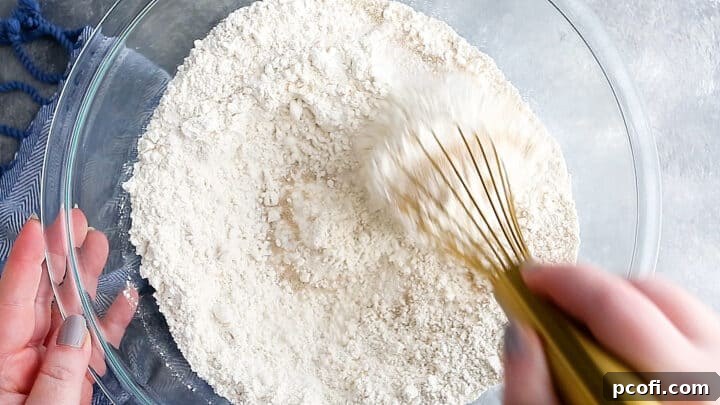
Begin by combining your dry ingredients: flour, sugar, yeast, and salt. Place them in a large mixing bowl and whisk them together thoroughly until they are uniformly distributed.
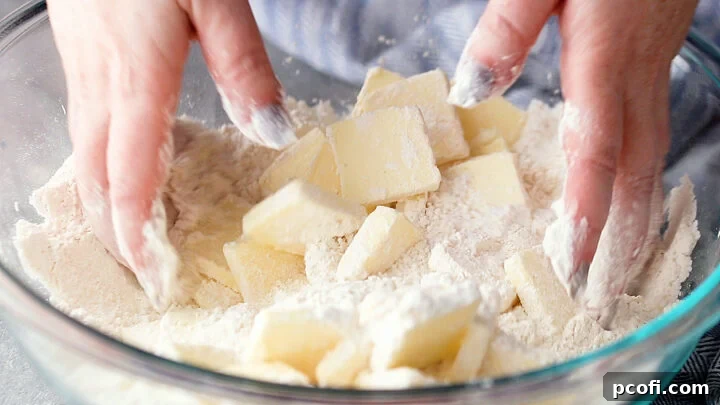
Next, introduce the star ingredient: cold, unsalted butter. Slice it into thin slivers, about 1/8-inch thick, and add them to the dry mixture. Toss the butter slices in the flour mixture, ensuring that each piece is well-coated. This initial coating helps prevent the butter from completely incorporating into the dough too early, preserving its ability to create distinct layers.
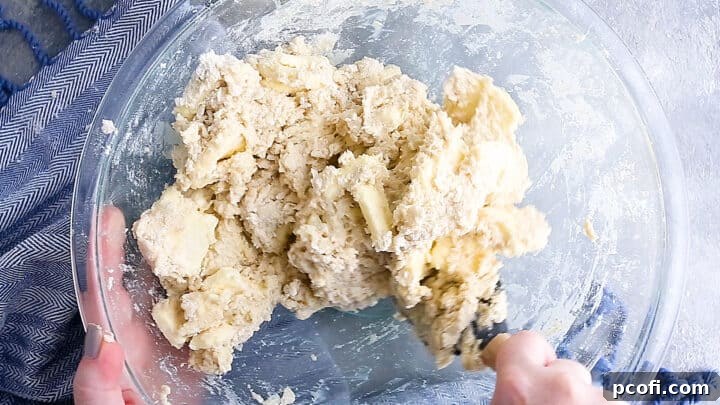
Now, pour in the cold milk. Using a silicone spatula or a sturdy wooden spoon, gently stir and fold everything together. Avoid using an electric mixer at this stage, as its powerful action could break down the cold butter too much, hindering the lamination process. Continue to fold and mix until the dough comes together to form a cohesive ball that pulls cleanly away from the sides of the bowl.
Important Note on Consistency: Remember that the amount of milk specified is a guideline. You may need slightly more or less to achieve the correct dough consistency. The dough should be quite stiff, not wet or sticky, resembling the texture shown in visual guides. It’s important to remember that the dough will continue to hydrate and firm up as it rests and chills.
Once your dough has formed, wrap it tightly in plastic wrap and place it in the refrigerator to chill for at least 1 hour. This crucial chilling period allows the butter to firm up and the gluten in the dough to relax, making it much easier to work with during the lamination process.
The Art of Laminating Croissant Dough
After the initial chilling, lightly flour your work surface and place the dough on it. Using a rolling pin, begin to gently flatten the dough, gradually encouraging it into a long rectangular shape. Don’t worry if it’s not perfectly even at this stage; the goal is simply to create a workable rectangle for the first fold.
Once the dough is sufficiently flattened, fold it into thirds, much like you would fold a letter. This initial fold begins the process of layering butter within the dough.
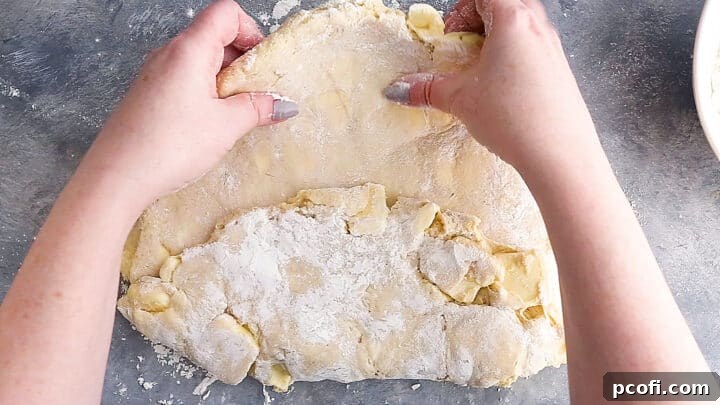
Initially, the dough might feel somewhat lumpy, bumpy, and a bit resistant to rolling. This is completely normal! With each subsequent roll and fold, the butter will become more evenly distributed and flattened, and the dough will gradually become smoother and more pliable.
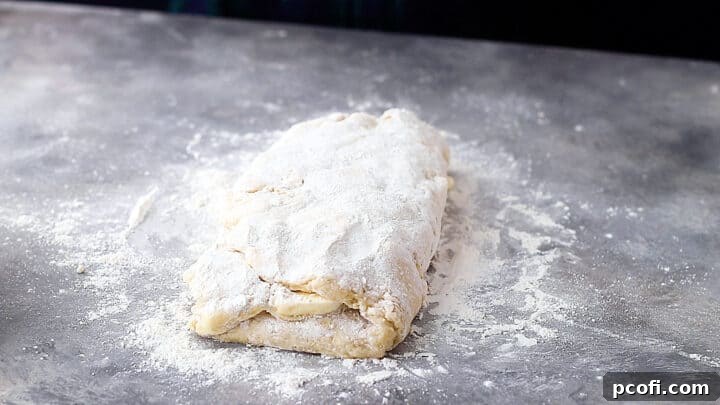
After folding the dough into thirds, rotate it 90 degrees and repeat the rolling and folding process. Continue this sequence for a total of 3 to 5 more times. Your goal is for the dough to develop large, visible streaks of butter within its layers, becoming smooth and flat overall.
Crucial Tip: Throughout this lamination process, if you notice the butter becoming too soft or starting to ooze, immediately wrap the dough tightly and chill it in the refrigerator (or even the freezer for a few minutes) until the butter stiffens again. Maintaining cold butter is paramount to creating distinct, flaky layers.
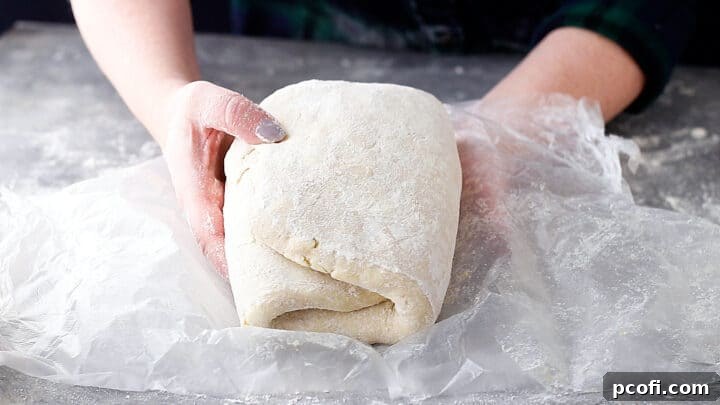
How Many Times Should Croissant Dough Be Folded?
Many traditional croissant recipes specify an exact number of folds, often creating unnecessary stress for bakers. We believe in a slightly more intuitive approach. The essence of a croissant lies in its countless flaky layers. While more folds generally mean more layers, there’s a point where the layers can become so thin they lose their individual integrity.
As you roll and fold, pay attention to the dough’s feel and appearance. Has the butter flattened into numerous thin sheets within the dough, or does it still feel lumpy? You’re aiming for numerous thin, even layers. You should clearly see distinct streaks of butter running through the dough, and the dough itself should lie flat and smooth, free from significant rough bumps.
For most home bakers, this optimal state is typically achieved after approximately 4 to 6 total folds, depending on how thinly the butter was initially sliced. Trust your judgment and the feel of the dough to guide you!
Shaping Your Beautiful Croissants
Once your dough is perfectly laminated, divide it in half to make it more manageable. On a lightly floured surface, roll each portion into a large, long rectangle. While precise measurements aren’t strictly necessary, aim for a rectangle that is roughly 10 inches wide, 22 inches long, and about 1/8-inch thick. This dimension will yield well-proportioned croissants.
Using a sharp knife or a pizza cutter, trim any uneven edges to create a neat rectangle. Then, cut the dough into long, skinny triangles, with the wide end of each triangle measuring approximately 5 inches across.
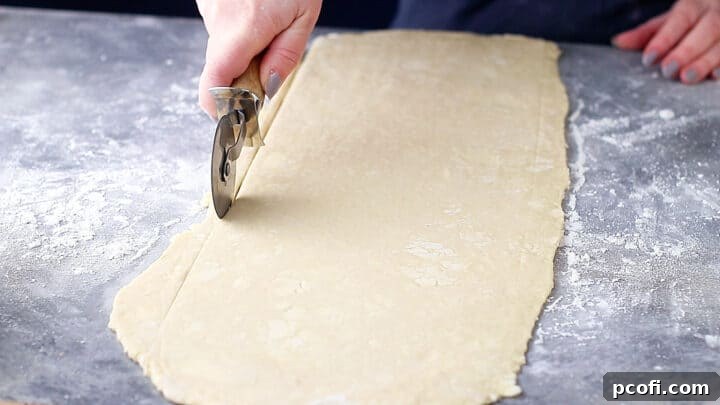
To aid in shaping, make a small notch, about 1/2-inch deep, in the center of the wide end of each triangle. This little cut helps the croissant bend and maintain its signature curved shape during rolling.
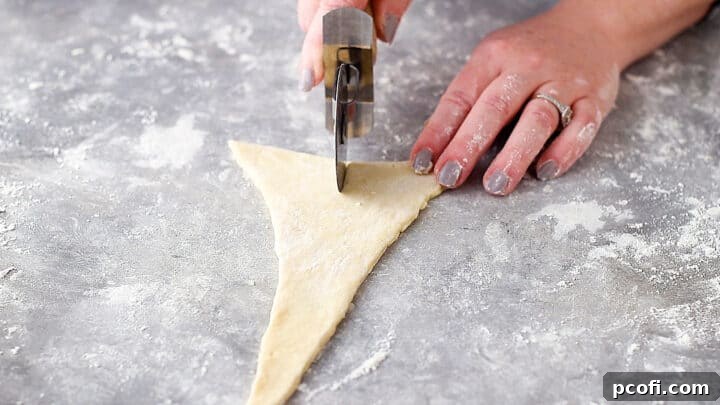
Starting from the wide, notched end of a triangle, gently roll the dough away from you towards the pointed end. As you roll, ensure the pointed tip is tucked neatly underneath the croissant to prevent it from unraveling.
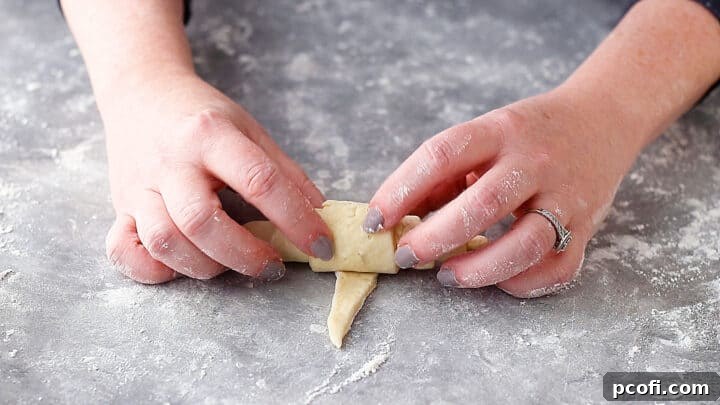
Once rolled, gently bend the croissant into its characteristic curved crescent shape, and lightly pinch the two ends together to secure. Place the shaped croissants on a baking sheet lined with parchment paper, ensuring enough space between them for rising.
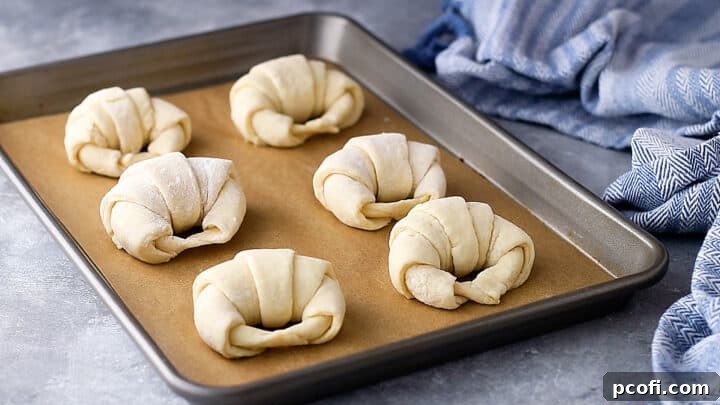
Lightly cover the unbaked croissants with greased plastic wrap and allow them to rise (proof) at room temperature until they have roughly doubled in bulk, typically 1 to 2 hours. This proofing stage is essential for the yeast to activate and create the airy interior.
For added convenience, you can transform this into an overnight croissant recipe! Simply place the trays of shaped croissants in the refrigerator for up to 48 hours. When you’re ready to bake, remove them from the fridge and allow them to come back to room temperature and rise as directed before baking.
Baking Your Homemade Croissants to Golden Perfection
Once your croissants have beautifully doubled in size after proofing, carefully remove the plastic wrap. Prepare an egg wash by whisking one large egg with a teaspoon or two of water until it reaches a brushable consistency. Gently brush this egg wash over the surface of each unbaked croissant.
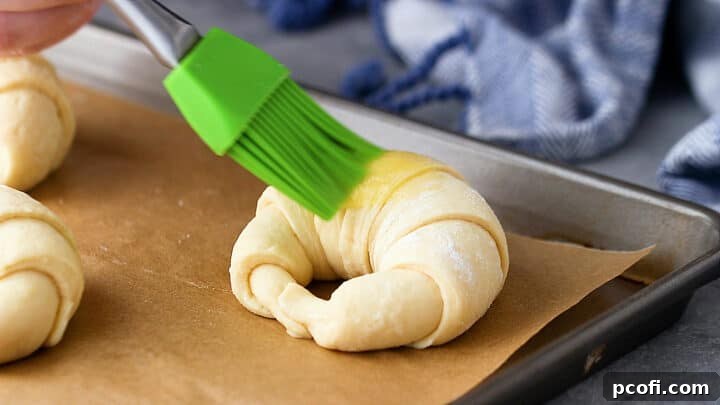
The egg wash is key to achieving that signature glossy sheen and a beautiful golden-brown crust on your baked croissants. Make sure your oven is fully preheated to 375 degrees F (190 degrees C). A hot oven is crucial! The high heat helps the moisture in the butter to rapidly create steam, causing those magnificent layers to puff up dramatically.
Bake for 15 to 20 minutes, or until your croissants are wonderfully puffed, gloriously golden brown, and visibly flaky. The aroma filling your kitchen will be pure bliss!
Delicious Ways to Enjoy Your Homemade Croissants
A freshly baked croissant, still warm from the oven, is a perfect indulgence on its own – its rich, buttery flavor and delicate flakiness require no embellishment. However, if you wish to elevate the experience, croissants offer a versatile canvas for a myriad of delightful accompaniments and fillings.
For a classic touch, spread them with a dollop of soft butter, or brighten them with a smear of sweet strawberry jam, tangy lemon curd, or comforting apple butter. These simple additions enhance their natural flavors beautifully.
Feeling adventurous? Stuff these delectable croissants before baking! A few pinches of chopped dark chocolate tucked into the wide end of the triangle before rolling will transform them into an exquisite pain au chocolat. Alternatively, for a savory twist, layer them with slices of ham and cheese – a truly irresistible combination.
Beyond breakfast and dessert, croissants also make fantastic vehicles for sandwiches. Split them horizontally and fill them with your favorite savory ingredients. A light and flavorful chicken salad on a croissant is an absolute delight, offering a gourmet alternative to traditional sandwich bread. The possibilities are endless for enjoying these versatile French pastries!
Frequently Asked Questions About Homemade Croissants
How do you store homemade croissants?
To keep your delicious **flaky croissants** fresh, store them in an airtight container at room temperature. They will retain their wonderful flavor and texture for at least a day, and often remain delicious for up to a week. If you need to extend their shelf life further, refrigerating them in an airtight container can keep them fresh for approximately 10 to 14 days. For optimal freshness, a quick reheat in a toaster oven can bring back some of their initial crispiness.

Can croissants be frozen?
Yes, baked croissants freeze exceptionally well! Like many other pastries and bread recipes, they can be frozen beautifully and will thaw in about an hour or less at room temperature. For best results, allow them to cool completely before freezing them in an airtight bag or container.
However, we generally do not recommend freezing unbaked croissants or raw croissant dough. While some bread doughs can be frozen, the delicate yeast and butter structure in croissant dough can be compromised by freezing and thawing, potentially affecting the rise and flakiness of the final product. There’s a higher chance the yeast won’t survive the freezing process, leading to less successful results.
What is laminated dough?
Laminated dough is a specialized pastry dough made through a technique of repeatedly folding butter into a base dough. This process creates alternating, extremely thin layers of dough and butter. When baked, the butter layers create steam, which separates and puffs up the dough layers, resulting in an incredibly light, airy, and distinctively flaky texture – a hallmark of pastries like croissants, puff pastry, and Danish pastries. It’s a true marvel of baking science!
Why are there chunks of butter in the dough?
Finding visible chunks of butter in your dough during the initial stages is perfectly normal and desired, as this is how the layers are created. However, if you observe very thick, uneven chunks of butter in the dough after several rounds of rolling and folding (lamination), it suggests that you need to continue the folding and rolling process further. The goal is to flatten and distribute the butter into thin, even streaks throughout the dough, rather than retaining large, isolated chunks.
It’s also important to note that if your butter is too cold just before baking, or if your oven isn’t fully preheated, your croissants might “leak” butter as they bake. The proofing process is crucial here; it allows the butter within the dough to slightly warm up to a pliable temperature, helping it stay encapsulated within the pastry layers rather than melting out into a pool on the baking sheet.

We genuinely hope this simplified **croissant recipe** inspires and encourages you to try making **homemade croissants**. It truly makes the process so much easier and far less daunting than traditional methods, while still delivering absolutely stellar results. There’s an immense satisfaction in pulling golden, **flaky croissants** from your own oven. Give it a try, and let us know what you think of your delicious creations!
As an Amazon Associate, I earn from qualifying purchases.
Easy Homemade Croissant Recipe
Yields: 15 croissants (approx.)
Prep Time: 40 mins
Cook Time: 20 mins
Resting Time: 4 hrs
Total Time: 5 hrs
This simplified croissant recipe will have you baking croissants like a pro. Flaky, buttery, and deliciously authentic, yet so easy to make!
Ingredients
- 4 cups (500 g) all-purpose flour
- 1/3 cup (78.86 g) granulated sugar
- 4 teaspoons (19.72 g) active dry yeast*
- 2 1/4 teaspoons (11.09 g) kosher salt
- 1 1/4 cups (283.75 g) unsalted butter, cold (2 1/2 sticks)
- 1 cup (244 g) milk, cold (you may need slightly more or less)
- Egg wash (1 large egg beaten with a teaspoon or two of water)
Instructions
- Place the flour, sugar, yeast, and salt in a large bowl and whisk together until combined.
- Slice the butter into 1/8-inch thick slices and toss in the flour mixture to coat.
- Add the milk and stir together until a stiff dough forms.
- Wrap the dough tightly in plastic wrap and chill for 1 hour.
- On a lightly floured surface, roll the dough into a long rectangle shape.
- Fold it into thirds (like a letter), turn 90 degrees, and repeat 3 to 5 more times, or until the dough has large streaks of butter in it but it is smooth and flat. (If at any point the butter starts to feel soft, chill it in the refrigerator or freezer until stiff.)
- Wrap tightly and chill for 1 more hour, then divide the dough in half and roll each portion to a thickness of about 1/8-inch, in a long rectangle shape (approx. 10-inches wide by 22-inches long).
- Cut the dough into long, skinny triangles (about 5-inches at the wide end).
- Notch the wide end of each triangle with about a 1/2-inch cut, then roll from the wide end to the pointed end, tucking the point under the croissant.
- Place on a parchment-lined baking sheet, cover loosely with plastic wrap, and allow to proof until doubled in size (1 to 2 hours).
- Preheat the oven to 375 degrees F, and gently brush the croissants with egg wash.
- Bake for 15 to 20 minutes, or until puffed, golden brown, and flaky.
Recipe Video
A visual guide to making these delicious homemade croissants.
Notes
- *Instant yeast may be substituted. Rise time may need to be reduced by 10 to 15 minutes. You’ll know your dough is done rising when it has doubled in volume.
- A few more French classics:
- Crusty French Baguette Recipe
- Basic Macaron Recipe
- Classic Eclairs
Nutrition
Calories: 294 kcal, Carbohydrates: 31g, Protein: 5g, Fat: 16g, Saturated Fat: 10g, Cholesterol: 42mg, Sodium: 360mg, Potassium: 92mg, Fiber: 1g, Sugar: 5g, Vitamin A: 500IU, Calcium: 29mg, Iron: 1.6mg
Cuisine: French
Course: Appetizer, Breakfast, Brunch, Side Dish, Snack
Tried this recipe?
Mention @bakingamoment on Instagram or tag #bakingamoment.