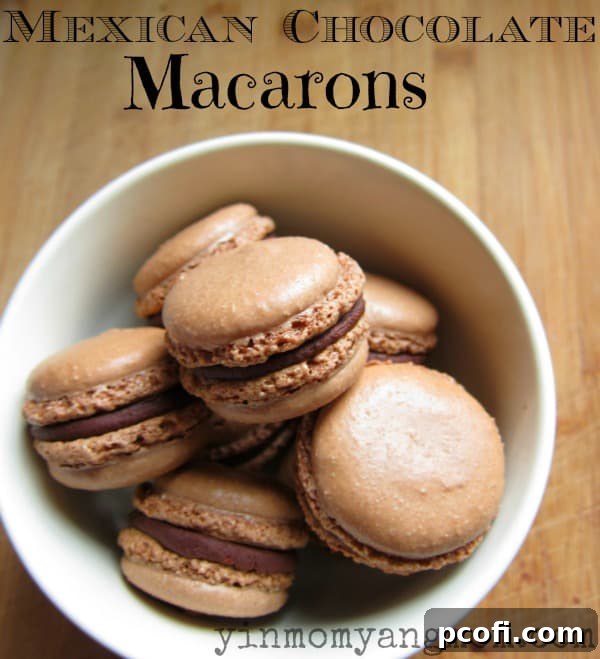
Mexican Chocolate Macarons: A Detailed Guide to Creating Spiced Chocolate Ganache Delights
**This post originally appeared on my other blog, YinMomYangMom.com.**
There’s an undeniable magic to the French macaron. These delicate, ethereal cookies, with their crisp shell and chewy interior, have captivated bakers and dessert enthusiasts worldwide. Today, we’re diving into a particularly enchanting variation: Mexican Chocolate Macarons. Imagine the classic elegance of a macaron, but infused with the warm, complex flavors of Mexican chocolate – a harmonious blend of rich cocoa, aromatic cinnamon, and a subtle kick of cayenne pepper. This recipe promises not just a treat for the taste buds, but a delightful baking adventure that culminates in truly exquisite homemade gifts or a luxurious indulgence for yourself.
For those who adore the sweet, marshmallowy, melt-in-your-mouth glory of French Macarons, prepare to fall in love all over again! This unique spin elevates the traditional chocolate macaron, adding a sophisticated depth that makes it perfect for any special occasion, especially during the holidays when a little extra spice is always welcome.
French Macarons!
Macarons have always held a certain allure, a touch of European mystique that sets them apart from other desserts. While they might seem intimidating to create at home, their reputation for being “tricky” is often exaggerated. With the right techniques, precise measurements, and a dash of patience, anyone can master these beautiful confections. This comprehensive guide is designed to demystify the macaron-making process, making it simple and foolproof even for beginners. We’ll walk through each step, from precise ingredient measurement to achieving that coveted “foot” on your macaron shells, ensuring your success in crafting these delightful treats.

Beyond their trendy appeal, macarons are incredibly adaptable to a myriad of flavors and colors, making them as visually stunning as they are delicious. This Mexican chocolate version, with its rich, dark shells and spiced ganache, offers a unique flavor profile that’s both comforting and exciting. Whether you’re a seasoned baker looking for a new challenge or a curious novice ready to impress, this in-depth tutorial is your key to macaron mastery. Get ready to transform your kitchen into a Parisian patisserie, one perfectly piped shell at a time!

One of the common complaints about baking, especially with intricate recipes like macarons, is the mountain of dirty dishes left behind. To combat this, I’m excited to share my streamlined measuring method, designed to minimize mess while maximizing accuracy. You’ll be surprised how clean your kitchen remains, even after whipping up a batch of these glorious French delights. Plus, to ensure you have everything you need, I’ve included helpful links to all the special equipment and quality ingredients that will set you up for absolute macaron success.
Step One: Precision in Measuring for Perfect Macaron Shells
The foundation of a perfect macaron lies in precise measurements. Unlike many baking recipes where a cup measure offers sufficient accuracy, macarons demand the exactness that only a kitchen scale can provide. If you don’t already own one, I highly recommend investing in a good quality kitchen scale, which you can find readily available online or at my shop. For those without a scale, approximate cup and teaspoon conversions are provided at the end of the recipe, but for truly consistent results, weighing is paramount.

Our measuring journey begins with the egg whites. Start by placing your largest mixing bowl – ideally the bowl from your stand mixer or the one you’ll use for the batter – onto your kitchen scale. Press “tare” to zero out the weight of the bowl. Carefully add your egg whites until you reach the desired weight. For this recipe, three egg whites typically weigh around 93 grams, yielding approximately sixteen 1.5 to 2-inch diameter macarons (or 32 individual shells). Make sure to note down this exact weight, as it will be the basis for all other ingredient quantities. For best results, use older, room-temperature egg whites, as they whip up to a better volume and stability.

Once your egg whites are weighed and set aside, it’s time to measure the dry ingredients. Place your sifting apparatus (like my favorite sifter) on the scale and zero it out. To determine the amount of almond flour needed, multiply your egg white weight by 1.1. So, for 93 grams of egg whites, you’ll need 102 grams of almond flour. This precise ratio is critical for the macaron’s delicate structure.

Next, with the sifter and almond flour still on the scale, zero it again. Now, calculate the powdered sugar by multiplying your egg white weight by 1.65. For 93 grams of egg whites, this translates to 153 grams of powdered sugar. However, since we’re creating delicious chocolate shells, we’ll swap out some of the powdered sugar for cocoa powder. Scoop out 2 tablespoons of the powdered sugar and replace it with an equal amount of high-quality cocoa powder, such as Scharffen Berger. This substitution ensures a rich chocolate flavor without compromising the macaron’s texture.

Sift all the dry ingredients – almond flour, powdered sugar, and cocoa powder – together through the fine-mesh sifter. Discard any larger pieces that don’t pass through, as these can disrupt the smooth texture of your macaron shells. Set the sifted dry mixture aside. For the superfine sugar, which will stabilize our meringue, multiply your egg white weight by 0.6. So, 93 grams of egg white x 0.6 equals 56 grams of superfine sugar. Measure this into a small, separate bowl. Preparing all your ingredients the night before, especially allowing egg whites to reach room temperature, significantly contributes to baking success.

I like to measure everything out the night before (hence the crappy photos. Sorry!). Older, room temperature egg whites will whip up better.
Now that our mise en place is complete, let the fun part begin!
Step Two: Mastering the Meringue and Macaronage
Achieving the perfect meringue is a cornerstone of macaron success. Begin by whipping your room-temperature egg whites in a clean, dry stand mixer bowl until they become foamy. This initial stage incorporates air, setting the stage for a stable meringue. Gradually, stream in the superfine sugar, continuing to whip the egg whites. The mixture will transform, becoming glossy, thick, and forming stiff peaks. It’s crucial not to overbeat the meringue, as this can dry it out and lead to fragile shells. The goal is a firm, shiny meringue that holds its shape beautifully.

Once your meringue is ready, it’s time for the “macaronage” – the delicate process of folding the dry ingredients into the meringue. Gently dump the sifted almond flour, powdered sugar, and cocoa mixture into the meringue. Using a spatula, fold the dry ingredients into the meringue. You’ll notice a slight loss of volume initially, but the key is to fold carefully, trying not to deflate too much of the precious air from your whipped egg whites. The folding motion should be smooth, scraping the sides and bottom of the bowl and turning the mixture over.

After approximately 40 strokes, or when the mixture is fully incorporated, you should achieve the ideal “macaronage” consistency. The batter should be somewhat stretchy and “gloopy,” flowing slowly and continuously off your spatula like molten lava. Think of the consistency of thick shower gel or perhaps a really runny hair mousse, for those of us who recall the 80s beauty trends! This perfect consistency is vital for smooth macaron shells and the development of the characteristic “feet” during baking. Undermixed batter will result in lumpy shells, while overmixed batter will be too thin and spread excessively.
Step Three: Piping, Drying, and Baking for Flawless Shells
With your macaron batter at the perfect consistency, it’s time to pipe. Scoop the batter into a large pastry bag fitted with a large, round tip – I find a Wilton 2A works wonderfully for consistent rounds. Line a heavy baking sheet with parchment paper or a silicone baking mat. Pipe half-dollar sized rounds, holding the bag vertically and applying even pressure. The batter should naturally flow and settle into smooth, even circles. If the batter is trying to escape the bag too easily or not holding its shape, it’s a sign your macaronage was spot on!

If it’s trying to escape while you’re filling your piping bag, then you mixed it right!
Once piped, rap the baking sheet firmly on your counter a few times. This helps to release any trapped air bubbles, preventing cracked shells. You can also use a toothpick to gently pop any remaining bubbles. Preheat your oven to 375 degrees F (190 C). Now, set your macaron shells out to dry, uncovered, at room temperature. This crucial step, known as “crusting,” allows a thin, dry membrane to form on the surface of the shells. This usually takes about 20-30 minutes, but humidity levels can significantly affect this time. The shells are ready when you can gently touch them without any batter sticking to your finger.

puddled
When the shells have crusted, pop them into the preheated oven. Immediately lower the temperature to 325 degrees F (160 C). Bake for 15 minutes. During this time, keep an eye on them; the lower temperature helps them bake through evenly and develop those desirable ruffled “feet” at the base. Once baked, remove the tray from the oven and let the macaron shells cool completely on the baking sheet. Resist the urge to peel them off too soon, as they will be fragile and may stick. Fully cooled shells will easily release from the parchment paper.
Step Four: Crafting the Spiced Mexican Chocolate Ganache Filling
While your macaron shells are resting and cooling, prepare the exquisite Mexican chocolate ganache filling. This ganache provides the perfect counterpart to the delicate chocolate shells, offering a burst of rich, spiced flavor. Begin by finely chopping 4 ounces of high-quality chocolate, such as Scharffen Berger. The quality of your chocolate directly impacts the richness and flavor of your ganache.

In a small saucepan, bring 1/4 cup of heavy cream to a gentle simmer over medium heat. Watch it carefully to ensure it doesn’t boil over. Once simmering, remove the cream from the heat and pour it directly over your chopped chocolate in a heatproof bowl. Let it sit undisturbed for a minute to allow the hot cream to melt the chocolate. Then, stir gently until the chocolate is completely melted and the mixture is smooth and glossy. This forms the base of our luxurious ganache.

To infuse it with that distinctive Mexican flair, stir in 1/2 teaspoon of ground cinnamon and a tiny pinch of cayenne pepper. The cinnamon adds warmth and aromatic sweetness, while the cayenne pepper provides a subtle, exciting heat that complements the chocolate beautifully without overpowering it. Allow the ganache to cool completely and firm up to a spreadable consistency. You can expedite this by placing it in the refrigerator, stirring occasionally, until it reaches the desired texture for piping or spreading.
(Optional) Step Five: Assembly, Maturation & Elegant Presentation
Once your macaron shells are perfectly cooled and gently peeled from the parchment, and your spiced Mexican chocolate ganache has reached its ideal consistency, it’s time for assembly. Pipe about a tablespoon of the cooled ganache onto the flat side of half of your macaron shells. Then, gently sandwich them with the remaining shells, pressing just enough to create a delightful filling-to-shell ratio without cracking the delicate meringue.

While they might be tempting to eat immediately, macarons are at their absolute best after a period of “maturation.” This allows the crisp shell to meld with the rich, moist filling, creating a harmonious texture and flavor experience. Store your assembled macarons in an airtight container in the refrigerator for at least 12-24 hours. This resting period transforms the separate elements into a single, sublime dessert. After maturation, they will keep well in the fridge for about three days, though they rarely last that long!
For an extra touch of elegance, consider presenting your homemade Mexican Chocolate Macarons as thoughtful gifts. I love arranging these little beauties on a bed of festive tissue paper and nestling them into a pretty box. It’s a truly special way to share your baking talents with the most cherished people in your life, offering a handmade treat that speaks volumes of care and affection.

Here’s that crucial measurement ratio one more time for your convenience:
- First, weigh your egg whites and record the number.
- Multiply that egg white weight by 1.1 to determine the exact amount of almond flour.
- Multiply the egg white weight by 1.65 for the correct quantity of confectioners’ sugar.
- Multiply the egg white weight by 0.6 to find the precise amount of superfine sugar needed.

Mexican Chocolate Macarons
Leave a Review
Save RecipeSaved!
Ingredients
- 1/4 cup heavy cream
- 4 ounces semisweet chocolate
- 1/2 teaspoon ground cinnamon
- 1 pinch cayenne pepper
- 3 egg whites
- 100 grams almond flour or almond meal, approx.1 cup + 1 tablespoon + 1 teaspoon
- 155 grams minus 2 tablespoons powdered sugar or confectioners sugar (approx. 1 3/4 cup + 2 tablespoons)
- 2 tablespoons unsweetened cocoa powder
- 55 grams superfine sugar, approx. 1/4 cup + 2 teaspoons
Instructions
-
Chop the chocolate.
-
Place the cream in a small saucepot and bring to a simmer.
-
Pour the cream over the chopped chocolate. Add the cinnamon and cayenne.
-
Stir to combine.
-
Sift the almond flour, powdered sugar, and cocoa powder together.
-
Whip the egg whites until foamy. Gradually add the superfine sugar, while whipping. Continue to whip until the meringue is stiff and glossy.
-
Fold the almond flour mixture into the meringue.
-
Pipe 2-inch diameter rounds of the batter onto a parchment lined baking sheet.
-
Preheat the oven to 375 degrees and let the piped shells sit out, uncovered, for approx. 30 minutes or until a thin, dry membrane has formed on the surface.
-
Drop the oven temperature down to 325 degrees and bake for 15 minutes.
-
Cool on the baking sheet.
-
Pipe about a tablespoon of cooled ganache onto half of the shells, and sandwich.
-
Makes about 16 pastries. Can keep in an airtight container for up to 3 days.

I understand that making French macarons can seem challenging, but with this detailed tutorial, I truly hope you feel confident and ready to achieve outstanding results. May your efforts bring you great success in the kitchen and plenty of smiles to the lucky individuals who get to enjoy these delightful treats!